
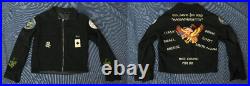
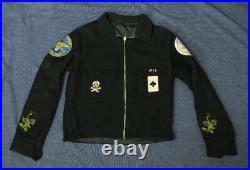
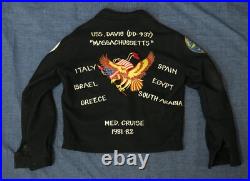
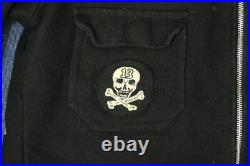

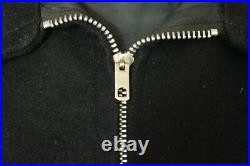

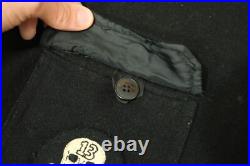
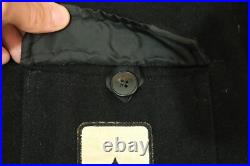
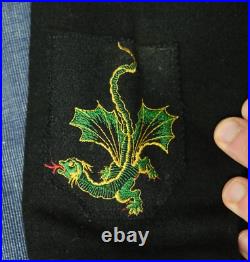


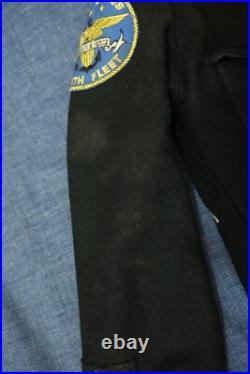
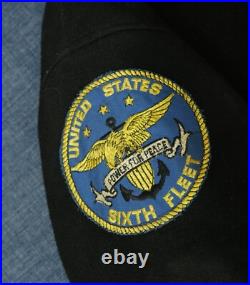
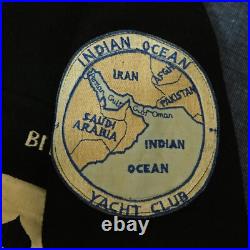
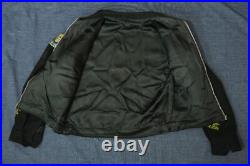
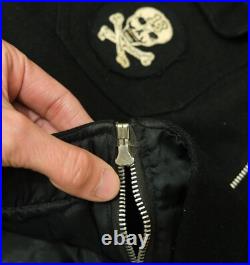
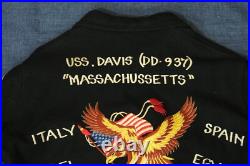
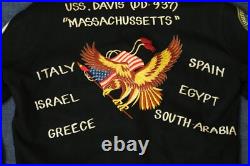
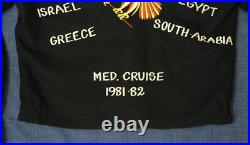


The front of the jacket has a skull and crossbones patch and a spade card with name “Bill” embroidered above. There are patches on each of the shoulders. Jacket is in excellent condition with minor dusty stain on right sleeve and but cuffs are missing the closure buttons. There are no holes in wool or on the liner and the zipper works great! 1 Chest (Armpit to Armpit – Doubled): 22-1/2″ Across – 45″ Doubled. 3 Overall Length (Base of Collar to Tip of Waist Hem): 24. 4 Outer Sleeve (Shoulder Seam to Tip of Sleeve Cuff): 24-1/2. 5 Inner Sleeve (Armpit to Tip of Sleeve Cuff): 20. Some history on the USS Davis (DD-937). Forrest Sherman -class destroyer. Laid down by the Bethlehem Steel Corporation at. On 1 February 1955. Killed in action at. On 6 January 1945, and posthumously awarded the. Was launched on 28 March 1956 by Mrs. Davis, widow of Commander Davis, and commissioned on 6 March 1957 at Boston Naval Yard. Departing Charleston for Guantanamo Bay on 13 March to begin five weeks of refresher training, visiting Port au Prince during a breather in the work, Davis next headed for Roosevelt Roads to conduct naval gunfire support exercises, climaxed with a visit to Charlotte Amalie, U. Returning to Charleston on 3 May, Davis underwent an IMAV/NWAI. Battle Group in ComPTUEx 2-81, conducting extensive ASW and AAW exercises during that time, after which she enjoyed rest and recreation at Frederiksted, U. Sailing for the Mediterranean on 13 August 1981, Davis reached Rota on 22 August and joined the Sixth Fleet. After departing Rota on 24 August, she transited the Strait of Gibraltar, then proceeded along the Spanish coast to Cartagena. Which she visited (26-30 August), providing “hotel services” while anchored out to submarine Whale. As the latter moored alongside. Moving on to Naples (2-5 September), she then conducted a War-At-Sea exercise with the Nimitz Battle Group (6-8 September) before conducting calling at Alexandria. Egypt (9-11 September) and Ashdod. Israel (13-23 September), receiving a tender availability alongside Puget Sound. At the latter port. Proceeding thence for the Suez Canal, Davis, accompanied by Voge, prepared for trouble in the wake of the recent signing of an accord between Libya, Ethiopia and Yemen, but accomplished the passage of the Bab-el-Mandeb. “With no confrontation” on the night of 27 September. After pausing for fuel at Djibouti (28 September 1981), Davis joined the America Battle Group for operations in the Arabian Sea (29 September – 18 October). Guided missile destroyer HMAS Hobart. Exchanging six people with her “down under” opposite number over each of the three days. Participating in a Gonzo Regatta at the conclusion of that period, competing in both gig and motor whaleboat events, Davis won the former race, with Rear Admiral Bryan W. Compton, Commander, Carrier Group 6, presenting the award to the boat officer. Transiting the Strait of Hormuz. On 19 October 1981, Davis entered the Persian Gulf for what would become “nearly constant underway time, ” punctuated by fuel stops and liberty at Bahrain and Jubayl. At the former place, Rear Admiral Charles E. And the Amir of Jubayl. Upon completion of the “surveillance and showing the flag tour” on 16 November, the destroyer headed west, made a high-speed passage of the Bab-el-Mandeb and Red Sea, then moored at Jiddah (23-25 November), hosting U. Ambassador to Saudi Arabia. As well as 200 Royal Saudi Navy. Students during that visit (24 November). Encountering heavy seas upon entering the Mediterranean, she then carried out exercises off the coast of Libya, transited the Strait of Messina. After a transit of the Strait of Gibraltar, Davis visited Rota for turnover procedures (9-11 December), then sailed for home with ComDesRon 20 embarked. She reached Charleston four days before Christmas, to begin the first of three shifts of leave for her people upon arrival and ending the year in normal inport routine. Following her post-deployment stand-down, and sea trials off Charleston, Davis departed her home port on 25 January 1982 for operations in the Caribbean and gunfire support exercises off Vieques. After visiting San Juan (1-5 February), she proceeded thence for a port call upon Port Everglades (7-11 February), where she embarked a group of sons of her officers and men for the cruise back to Charleston, where she arrived on 13 February. Following two NWAT visits (19-21 May 1982 and 7-9 June) and an ammunition onload at the Naval Weapons Station, Charleston (21-22 June), Davis conducted ASW exercises in the operating areas off her home port, utilizing the services provided by two submarines and ASW P-3C Orions. Over the ensuing months (July-August), the crew learned of growing evidence to expect de-commissioning in late December… Joining the America Battle Group off the Virginia capes, Davis steamed across the North Atlantic, conducting exercises and replenishing from NATO warships off the Irish. Coast, steaming into the region of the Shetland Islands. And into the North Sea. Where the group disbanded and Davis proceeded independently into the English Channel (15 September), and mooring at Southampton. England, on 16 September, the first U. Navy warship in recent memory to visit that port. Underway on 22 September 1982 for the short transit to Brest, France. Davis visit (23-26 September) was cut short by growing tensions in the eastern Mediterranean, in and around Lebanon. Davis rejoined the America Battle Group to conduct “contingency operations” and transited the Strait of Gibraltar, then proceeded immediately into the Ionian Sea. To exercise with elements of the Turkish. Navies (“the first such joint effort, ” Davis’s chronicler noted, “between [those] two navies in recent times”) as well as other NATO units during exercise Display Determination 82.