
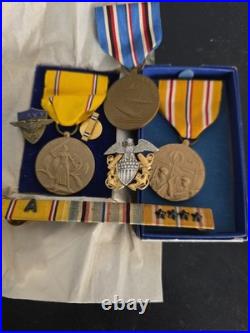
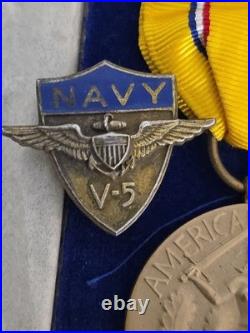
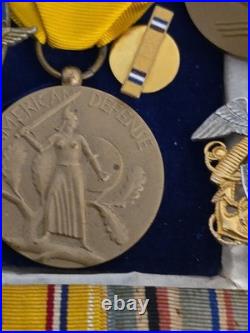
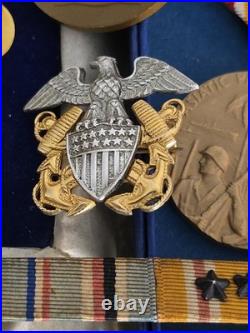
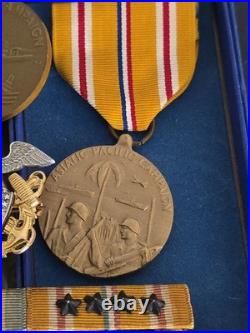
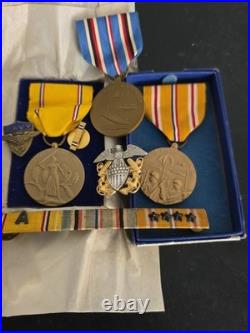
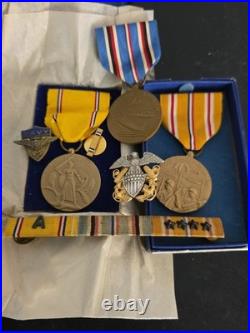
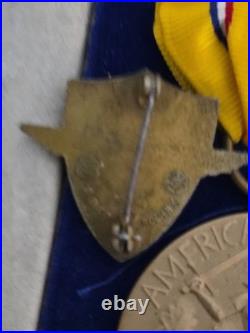
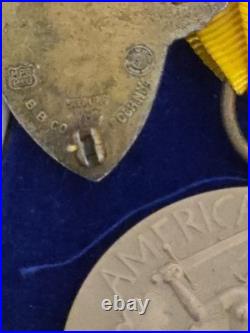
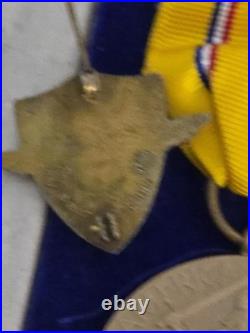
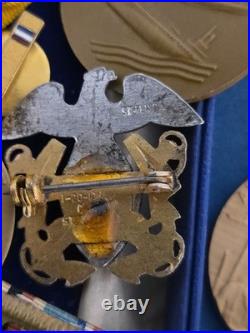
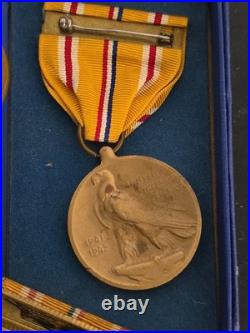
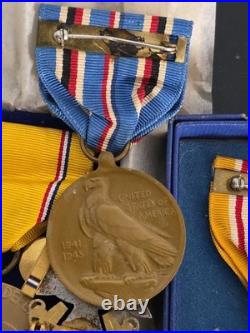
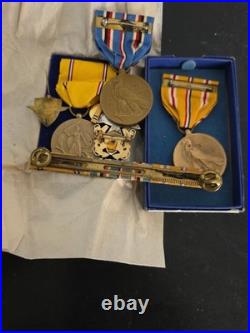
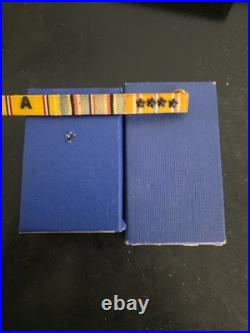
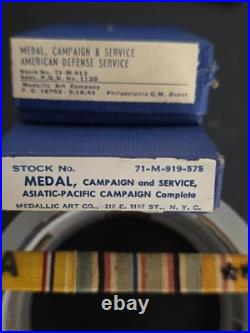
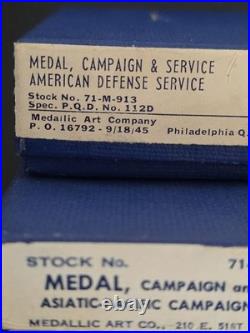
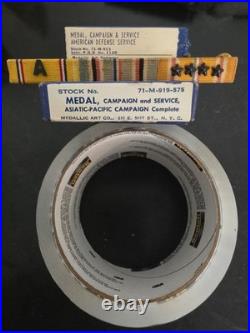
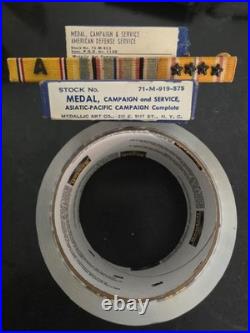
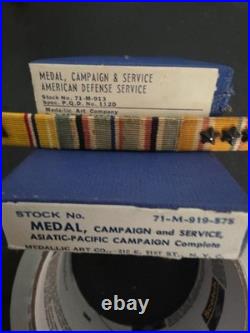

PLEASE FOLLOW OUR E BAY STORE. PLEASE READ WHOLE ADD. We want your repeat business. We get by having best prices on the net. V5 AND OFFICER BADGE ARE BOTH STERLING SILVER. During World War II, the USN pilot training program started to ramp up. It had the same stages as the army aviation program. (pre-flight, primary, basic, and advanced), except basic flight added a carrier landing stage for fighter and torpedo- or dive-bomber pilots. In 1940, it was modified to be more like the V-7 program of the United States Naval Reserve Midshipmen’s School. Candidates had to attend two 4-month semesters (or 10-week “quarters”) of college before attending pre-flight. Pre-flight was divided into flight preparatory school, pre-Midshipman School, and Midshipman School. Flight Preparatory School was a four-week “boot camp” that taught discipline and drill, etiquette and protocol (as an officer was expected to be a gentleman), and ethics (as an officer was expected to be honorable); graduates became Seamen Second Class. Pre-Midshipman School was four months of accelerated academic coursework in science, math and physics for those candidates between the ages of 17 and 20 who did not have the educational requirements to attend Midshipman School; graduates became midshipmen. Engineering, leadership, and naval military history; graduates became commissioned as Ensigns in the US Naval Reserve. Those that washed out were placed in the general V-6 pool as Seamen Second Class in the Naval Reserve. V-5 Pre-Flight Schools were established in five locations: at the University of Iowa. In Iowa City (opened on 15 April 1942). At the University of North Carolina. At Chapel Hill (established on 1 February 1942, opened that May). At the University of Georgia. Campus in Athens (contract NOd3035 signed on 19 March 1942, and opened on 18 June 1942). And two in California: at St. In Moraga, and at the Hotel Del Monte. Was in the first V-5 class at Iowa, where the aspiring carrier fighter pilots were nicknamed the Seahawks. Personnel at Chapel Hill included future presidents George Bush. Where they were known as the Cloudbusters. Cadets in California included Ed McMahon. Mary’s, they were known as the Air Devils. Their nickname at Georgia was the Skycrackers. In early 1943, flight preparatory schools were established at 17 colleges and universities. In July, 1943 the V-5 and V-7 programs were merged into the new V-12 Navy College Training Program. V-5 students were reclassified as V-12A (with the A standing for Aviation). Candidates had to attend four 4-month semesters (or 10-week “quarters”) of college before attending Pre-Flight or could opt to transfer to the NROTC. The V-12 program differed in that it was focused on college education and it eliminated the Naval Flight Preparatory School and War Training Services stages. Primary Flight School was at NAS Pensacola. And it taught basic flying and landing. It used the NAF N3N. Primary trainers, dubbed “Yellow Perils” from their bright yellow paintscheme (and the inexperience of the student pilots). Basic Flight School was broken into two parts: part one taught instrument flying and night flying and part two taught formation flying and gunnery; an additional part three stage for single-engined aircraft pilots taught carrier landing. They used the North American SNJ. Advanced Flight Training qualified the pilot on either a single-engined fighter, dive-bomber or torpedo bomber or a multiple-engined transport, patrol plane or bomber; graduates were classed as Naval Aviators and received gold Naval Aviator wings. Each graduate had around 600 total flight hours, with approximately 200 flight hours on front-line Navy aircraft. Pilots who washed out were assigned as regular ensigns. In 1942 alone the program graduated 10,869 aviators, almost twice as many as had completed the program in the previous 8 years. In 1943 there were 20,842 graduates; in 1944, 21,067; and in 1945 there were 8,880. Thus in the period 1942 to 1945, the U. Navy produced 61,658 pilots – more than 2.5 times the number of pilots as the Imperial Japanese Navy. Awarded to any member of the Navy who served duty in actual or potential belligerent contact with Axis Powers. In the Atlantic Ocean. Between June 22 and December 7, 1941. The “A” Device was also worn on the medal’s uniform ribbon. American Defense Service Medal. Service between 8 September 1939 and 7 December 1941. And Department of the Navy. September 8, 1939 (retroactive). December 7, 1941 (retroactive). About 2,000,000. Military service in the American Theater for at least 30 days outside the U. Or 1 year inside the U. Between December 7, 1941, and March 2, 1946. Served in the U. Armed forces for at least 30 days in the Asiatic-Pacific Theater between December 7, 1941, and March 2, 1946. The Asiatic-Pacific Campaign Medal. Was a United States. Of the Second World War. Which was awarded to any member of the United States Armed Forces. Who served in the Asiatic-Pacific Theater. From 1941 to 1945. The medal was created on November 6, 1942, by Executive Order. Issued by President Franklin D. The medal was designed by Thomas Hudson Jones. The reverse side was designed by Adolph Alexander Weinman. Which is the same design as used on the reverse of the American Campaign Medal. And European-African-Middle Eastern Campaign Medal. There were 21 Army and 48 Navy-Marine Corps official campaigns of the Pacific Theater, denoted on the suspension and service ribbon. Of the medal by service stars. Which also were called “battle stars”; some Navy construction battalion. Units issued the medal with Arabic numerals. Is authorized for those campaigns which involved participation in amphibious assault landings. The Fleet Marine Force Combat Operation Insignia. Is also authorized for wear on the medal for Navy service members who participated in combat while assigned to a Marine Corps unit. The flag colors of the United States and Japan. Are visible in the ribbon. The Asiatic-Pacific Campaign Medal was first issued as a service ribbon in 1942. A full medal was authorized in 1947, the first of which was presented to General of the Army. Equivalent of the medal was known as the European-African-Middle Eastern Campaign Medal. Boundaries of Asiatic-Pacific Theater. (1) The eastern boundary is coincident with the western boundary of the American Theater. (2) The western boundary is from the North Pole south along the 60th meridian east longitude to its intersection with the east boundary of Iran, then south along the Iran boundary to the Gulf of Oman and the intersection of the 60th meridian east longitude, then south along the 60th meridian east longitude to the South Pole. The 43 officially recognized US Navy campaigns in the Pacific Theater of Operations are. Pearl Harbor: Pearl Harbor. 8 December 1941 – 6 May 1942. Netherlands East Indies engagements. 23 January – 27 February 1942. 1 February – 10 March 1942. 7-9 August 1942 (First Savo). Capture and defense of Guadalcanal. 10 August 1942 – 8 February 1943. Buin-Faisi-Tonolai raid: 5 October 1942. 11-12 October 1942 (Second Savo). 12-15 November 1942 (Third Savo). 30 November – 1 December 1942 (Fourth Savo). Eastern New Guinea operation. 17 December 1942 – 24 July 1944. Consolidation of Solomon Islands. 8 February 1943 – 15 March 1945. 26 March – 2 June 1943. New Georgia Group operation. 20 June – 16 October 1943. Bismarck Archipelago operation: 25 June 1943 – 1 May 1944. Pacific raids (1943): 31 August – 6 October 1943. Operation: 27 October – 15 December 1943. 13 November – 8 December 1943. 26 November 1943 – 2 March 1944. Asiatic-Pacific raids (1944): 16 February – 9 October 1944. Western New Guinea operations. 21 April 1944 – 9 January 1945. 10 June – 27 August 1944. Western Caroline Islands operation. 31 August – 14 October 1944. 10 October – 29 November 1944. 12 December 1944 – 1 April 1945. 15 February – 16 March 1945. 17 March – 30 June 1945. Third Fleet operations against Japan. 10 July – 15 August 1945. 1 February 1944 – 11 August 1945. 27 April – 20 July 1945. Tinian capture and occupation. 24 July – 1 August 1944. Consolidation of the Southern Philippines. 28 February – 20 July 1945. 21 April – 1 June 1944. 29 January – 16 April 1945. Escort, antisubmarine, armed guard and special operations: 7 December 1941 – 2 September 1945. Submarine War Patrols (Pacific). 7 December 1941 – 2 September 1945. PLEASE SEE STORE WW1- WW2 MEDALS -STERLING SILVER BADGES – RARE COINS PCGS GRADED /RARE GRADED CURRENCY.