
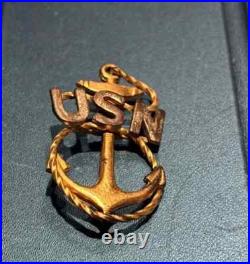
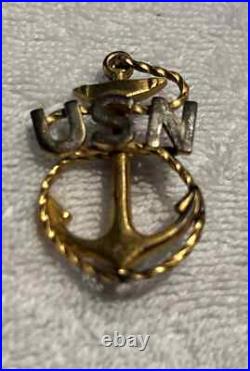
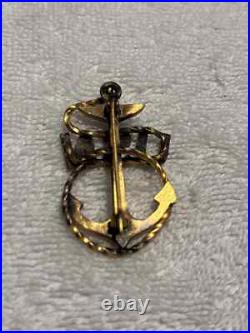
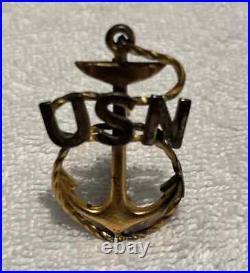
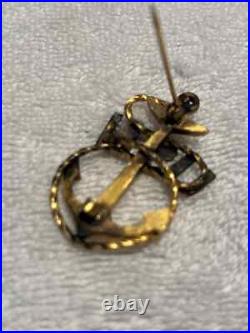
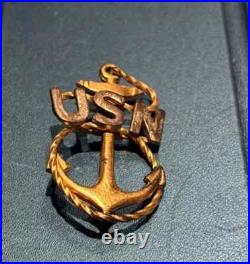

PLEASE FOLLOW OUR E BAY STORE. PLEASE READ WHOLE ADD. We do not want your feed back. We want your repeat business. We get by having best prices on the net. The product is an authentic WW1 US Navy Chief Petty Officer CPO cap hat badge insignia pin. This original period item from the United States features the iconic insignia of a Chief Petty Officer in the navy, making it a valuable collectible for militaria enthusiasts. The badge is a genuine piece of history from World War I, adding to its significance and appeal to collectors interested in military memorabilia from this era. History of the Chief Petty Officer Grade. By CWO-4 Lester B. Master Chief Petty Officer of the Navy Home Page. Chief Petty Officer Recipients of the Medal of Honor. Chief Petty Officers’ Uniforms U. Individuals serving as Master Chief Petty Officer of the Navy 1967-present. Master Chief Boatswain’s Mate Carl Maxie Brashear, USN Ret. One Hundred Years of Leadership. A message from CNO Adm Frank B. Kelso II – 100th anniversary of the creation of the rank of Chief Petty Officer, 1 April 1993 Personal Appearance. US Navy Interviewer’s Classification Guide. USS Chief II (MCM-14). Reprinted from Pull Together: Newsletter of the Naval Historical Foundation and the Naval Historical Center, Vol. It is a sure bet that one of the proudest days in an enlisted individual’s naval service is the date on which a first class petty officer dons the uniform and is accepted into the Chief Petty Officer community. At this time, the PO1’s leadership and professional abilities are recognized by superiors. These qualities continue to be honed with experience and maturity until retirement. This article covers the history of the grade of Chief Petty Officer. April 1, 1993, marked the 100th anniversary of the creation of that grade. It is necessary, however, to look back to the origins of the Continental Navy to establish the foundation of relative grades and classifications that led to the ultimate establishment of the CPO grade. During the Revolutionary War, Jacob Wasbie, a Cook’s Mate serving on board the Alfred, one of the first Continental Navy warships, was promoted to “Chief Cook” on June 1, 1776. This is the earliest example of the use the term “Chief” located to date by the author. The United States Navy was reauthorized under the Constitution by an act of March 27, 1794. The fledgling Navy was to consist of four forty-four gun frigates and two thirty-six gun frigates. The action taken by Congress on that date was based upon the need to counter the Algerian pirates. However, a treaty was reached between the United States and Algiers prior to completing any of the vessels, and the act was allowed to expire. The construction or completion of three frigates was later directed under an act of July 1, 1797. Personnel allowed to the two classes of warships were the same under both acts. Petty officers, who were appointed by the Captain, consisted of one Captain’s Clerk, two Boatswain’s Mates, a Coxswain, a Sailmaker’s Mate, two Gunner’s Mates, one Yeoman of the Gun Room, nine Quarter Gunners (eleven were allowed for the two larger vessels), two Carpenter’s Mates, an Armorer, a Steward, a Cooper, a Master-at-Arms, and a Cook. Non-petty officers, as listed in the 1797 act, consisted of 103 Ordinary Seamen and Midshipmen and 150 Able Seamen for the larger frigates; the smaller vessel, Constellation, was allowed 130 Able Seamen and Midshipmen and 90 Ordinary Seamen. The 36 gun frigate was allowed 1 less Sergeant and Corporal and 40 rather than 50 Marines. Generally speaking, precedence of petty officers was not really introduced until the U. Navy Regulations, approved February 15, 1853, were published. It must be pointed out that those regulations were declared invalid by the Attorney General on May 3, 1853, and were rescinded due merely to the fact that the President rather than Congress approved them. However, this did not mean that the information and the guidelines contained in them were inaccurate. Conversely, the Secretary of the Navy submitted a set of naval regulations for Congressional acceptance on December 8, 1858, but they were never acted upon in that session of Congress. Prior to 1853, one could infer a quasi-precedence of ratings based upon the sequence in which ratings were listed within complement charts; this is backed by differences in pay of various petty officers. Another issue to be considered is the fact that the order of the names of the petty officers as they appeared on muster rolls could generally be considered an order of precedence. Precedence of ratings was explicitly spelled out in Navy Regulations approved on March 12, 1863. Petty officers were listed under two categories – Petty Officers of the Line and Petty Officers of the Staff as shown in Table 1. ” That lengthy paragraph was shortened in the 1865 regulations to read simply, “Precedence among Petty Officers of the same rate shall be established by the Commanding Officer of the vessel in which they serve. Precedence of ratings remained in effect until the issue of Change #17 of August 15, 1968, to the 1959 Bureau of Naval Personnel (BUPERS) Manual. At that time, precedence among ratings was eliminated and changed to a single system for military and non-military matters based on pay grade and time in grade. However, if one tries to enlighten some of them they will usually get their danders up and argue until red in the face. It is not the intention of this synopsis to present an extended dissertation on individual ratings. However, at this point, clarification of a longstanding controversy and its resultant misconceptions regarding the Chief Boatswain’s Mates, Chief Gunner’s Mates, and Chief or Signal Quartermasters of the 1864-93 era is necessary. Those three ratings have at one time or another been erroneously identified and argued as being Chief Petty Officers. Among the ratings included were Chief Boatswain’s Mate, Boatswain’s Mate in Charge, Boatswain’s Mate, Chief Gunner’s Mate, Gunner’s Mate in Charge, Gunner’s Mate, Chief Quartermaster and Quartermaster. The primary difference between the Chief Boatswain’s Mate and Boatswain’s Mate in Charge and the Chief Gunner’s Mate and Gunner’s Mate in Charge lay in their assignments. They were last listed in the pay table included in the Navy Register for July 1, 1869, and were eliminated from this list with the issue of January 1, 1870. From that date, according to complements set in 1872, Chief Boatswain’s Mates and Chief Gunner’s Mates were assigned to vessels of all four classes. The title of Chief or Signal Quartermaster was mentioned in the 1863 Regulations and requires explanation. The term Signal Quartermaster was utilized from at least the early 1800s. Furthermore, the 1863 Navy Regulations and the 1864 pay order did not present a distinction between those two titles. In 1865, however, by U. Navy Regulations approved April 18, 1865, a distinction was made between Quartermaster (not Chief Quartermaster, which was never listed) and Signal Quartermaster listed under Petty Officers of the Line. Signal Quartermaster was listed as third in precedence (after Gunner’s Mate), whereas Quartermaster was sixth (after Coxswain to Commander in Chief of a Squadron or Fleet). Those two ratings continued to be carried in successive issues of Navy Regulations until 1885. It is of note that Signal Quartermaster was never listed as a separate rate from Chief Quartermaster in the pay tables covering those twenty years. Therefore, the title of Signal Quartermaster, instead of Chief Quartermaster, can be considered as the official title from April 18, 1865, to January 8, 1885. The title of Chief Quartermaster, primarily found in Navy pay tables for that same period, can be judged to be an alternate or common-use title for Signal Quartermaster. In other directives and correspondence these two titles were often used interchangeably. It is necessary to reflect back to Chief Boatswain’s Mates and Chief Gunner’s Mates to define their exact status. Navy Regulations of 1865, 1870, and 1876 fail to show Chief Boatswain’s Mate and Chief Gunner’s Mate as different rates or levels from Boatswain’s Mate and Gunner’s Mate respectively. It therefore follows that to justify calling the Chief Boatswain’s Mate and the Chief Gunner’s Mate additional rates one has to depend upon General Order 36 of May 16, 1864 (effective July 1, 1864), and Tables of Allowances for the 1870s which list them as rates or ratings along with Boatswain’s Mate and Gunner’s Mate. To answer the question of whether the Chief Boatswain’s Mate, Chief Gunner’s Mate, and Chief Quartermaster or Signal Quartermaster of the 1863-93 era were or were not actually Chief Petty Officers is elementary. They were not Chief Petty Officers due to the fact that the grade had not yet been created. Fifty-three weeks later, on January 8, 1885, the Navy classed all enlisted personnel as first, second, or third class for petty officers, and as Seaman first, second, or third class for non-petty officers. Included under the Special Branch at the second class petty officer level was the rate of Chief Musician who was junior to the Band Master. That rate was changed to First Musician under the 1893 realignment of ratings was and carried as a petty officer first class until 1943. On April 1, 1893, two important steps were taken. First, the grade of Chief Petty Officer was established; secondly, most enlisted men received a pay raise. The question is often asked, Who was the first Chief Petty Officer? ” The answer is flatly: “There was no first Chief Petty Officer due to the fact that nearly all ratings carried as Petty Officers First Class from 1885 were automatically shifted to the Chief Petty Officer level. Therefore, the Chief Petty Officer grade on April 1, 1893, encompassed the nine rates shown in Table 2. Men served various lengths of time under acting appointments, generally six months to a year. If service was satisfactory, the captain recommended to the Bureau of Navigation (called the Bureau of Personnel, BUPERS, after October 1, 1942) that an individual be given a permanent appointment for the rate in which he served. Otherwise the commanding officer could reduce an individual to the grade or rate held prior to promotion if he served under an acting appointment. The change in status from acting to permanent appointment was always a “breathe-easier” occurrence. This meant that the commanding officer could not reduce a Chief Petty Officer in rate if he messed up. It took a court-martial and the Bureau’s approval to reduce a Chief serving under a permanent appointment. The letters “PA” and “AA” were written alongside rate titles and their abbreviations. Those letters stood for permanent appointment and acting appointment, and were used to signify a Chief Petty Officer’s status. After March 8, 1946, the letter “A” (for acting appointment) was used integrally with the rate abbreviation. For example, Chief Boatswain’s Mate with an acting appointment was abbreviated CBMA. Pay grade 1-A no longer signified acting appointment for Chief Petty Officers after October 1, 1949, as affected by the Career Compensation Act of October 12, 1949. From that time, CPOs received the same pay regardless of whether they held permanent or acting appointments. On November 1, 1965, acting appointments were dropped from use. A pay differential existed between permanent and acting appointments until 1949. CPOs holding permanent appointments dated prior to July 1, 1903, were required to requalify by standing an examination before a board of three officers. If they passed, they were issued permanent appointments by the Bureau of Navigation. Pay levels for enlisted men at that time were established by executive order until July 1, 1908. An act of May 13, 1908, established that the U. Congress would set pay for enlisted men. However, during the Depression, President Franklin D. Roosevelt, by executive order alone, temporarily decreased the pay of all Armed Forces personnel by 15 percent from April 1, 1933, to June 30, 1934, and 5 percent from July 1, 1934, to June 30, 1935. Chief Petty Officer Ratings on April 1, 1893. Chief Master-at-Arms Chief Boatswain’s Mate Chief Quartermaster Chief Gunner’s Mate. Chief Machinist Chief Carpenter’s Mate. Chief Yeoman Apothecary Band Masters. The act of May 18, 1920, effective January 1, 1920, standardized pay at all levels from the lowest non-rated grade, which was Apprentice Seaman, through Chief Petty Officer. These pay rates remained effective until June 1, 1942. By an act of June 10, 1922, which became effective July 1, 1922, the pay grades of 1 and 1-A to 7 were established. CPOs (PA) and Mates were carried in pay grade 1 whereas Chiefs with Acting Appointments were listed in pay grade 1-A. On October 1, 1949, by the Career Compensation Act of October 12, 1949, pay grades were reversed and the letter E, for enlisted, was added setting all Chief Petty Officers at E-7 vice pay grades 1 and 1-A. The pay grades of E-8 and E-9, Senior Chief and Master Chief, were created effective June 1, 1958, under a 1958 Amendment to the Career Compensation Act of 1949. Eligibility for promotion to E-8, the Senior Chief level, was restricted to Chiefs (Permanent Appointment) with a minimum of four years in grade and a total of ten years of service. For elevation from E- 7 to Master Chief, E-9, a minimum of six years service as a Chief Petty Officer with a total of 13 years service was required. People holding those ratings were absorbed or converted to Yeoman or Radioman from Teleman and primarily to Lithographer from Printer. Service-wide examinations for outstanding Chiefs were held on August 5, 1958, with the first promotions becoming effective on November 16, 1958. A few months later, a second group of Chiefs from the February 1959 examinations were elevated to E-8 and E-9 effective on May 16, 1959. The names of the first two groups of selectees are listed in Bureau of Naval Personnel Notices 1430 of October 17, 1958, and May 20, 1959. It is noted that after the May 1959 elevations, promotions to E-9 were through Senior Chief only. On July 1, 1965, compression of several ratings at the two top grades was enforced. Conversely, about four years later, on February 15, 1969, some expansion at the Senior and Master Chief grades eliminated Master Chief Steam Propulsionman. Expanded rates included Master and Senior Chief Torpedoman’s Mate, Quartermaster, and Storekeeper. Seven ratings were reestablished at the E-8 and E-9 grades, presenting the opportunity for Chiefs to again advance within their specialty to E-9. The seven affected ratings were Signalman, Mineman, Aircrew Survival Equipmentman, Aviation Storekeeper, Aviation Maintenance Administrationman, and Boiler Technician. Only two ratings have remained in continuous use since 1797–Boatswain’s Mate and Gunner’s Mate. The service of all senior enlisted personnel, past, present and future, are recognized in their centennial year, aptly marked by the theme, One Hundred Years of Leadership. Tucker, USN (Retired), enlisted in the Navy in 1939; for the next 27 years he served as Gunner’s Mate Third Class, Aviation Ordnanceman Third Class, Aviation Chief Ordnanceman, and Warrant Gunner (Aviation). Since 1974, he has conducted extensive research on the history of U. Navy ratings from the Revolutionary War to the present for a multi- volume series on that topic. Naval warfare of World War I. Part of World War I. Clockwise from top left: the Cornwallis. Fires in Suvla Bay, Dardanelles. In practice in the final stages of the war; manoeuvres of the Austro-Hungarian fleet. July 28, 1914 – November 11, 1918.