
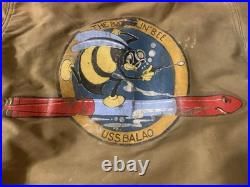
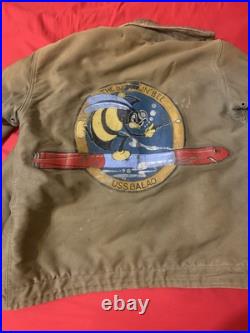
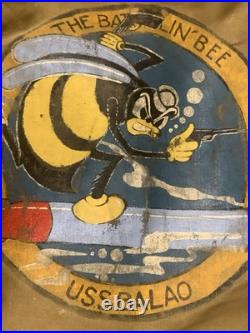
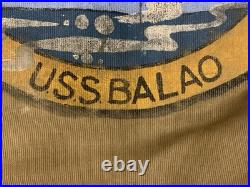
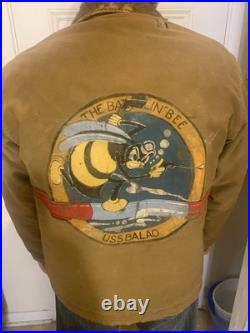
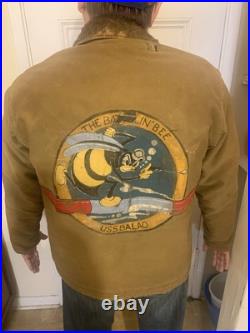
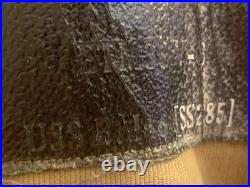
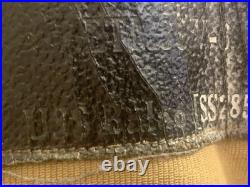
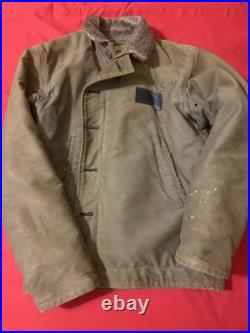
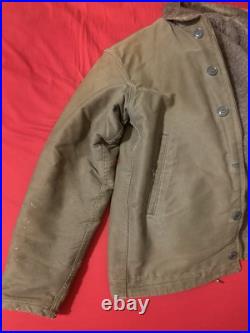
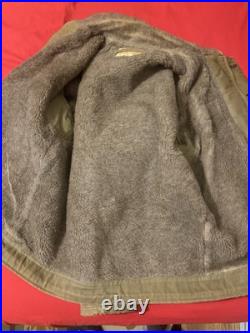
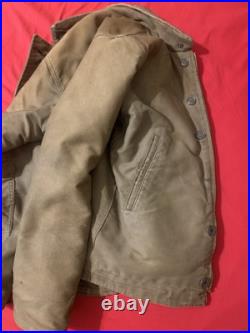
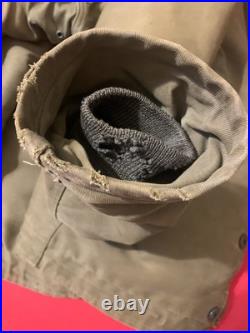
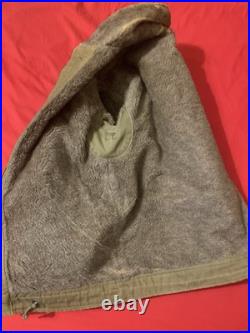
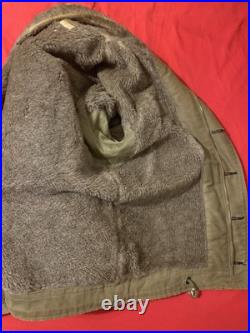
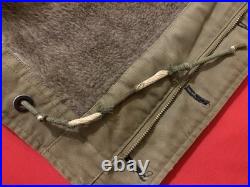

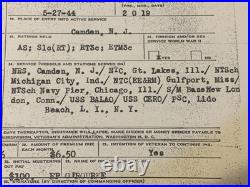
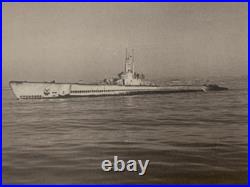

World War II Original 1944 Submariner. Chance in a lifetime opportunity to own a piece of wardrobe from a submariner from our Greatest Generation! Collar is frayed from age/Zipper no longer works. Jacket is 24 inches long/Sleeves are 24 inches long/ Painted USS Balao Emblem 11.50 high x 18.50 long. Give yourself, a loved one, or that special friend, the best gift ever! And named for the. A small schooling marine fish. On 26 June 1942 at the Portsmouth Navy Yard. She was launched on 27 October 1942, sponsored by Mrs. Jane Aylward, wife of Lieutenant Commander. Aylward, commissioned on 4 February 1943 and reported to the United States Pacific Fleet. After a six-week training period in New London, Conn. The submarine sailed for the Pacific Theater of Operations. And joined the 7th Fleet. Australia, on 10 July 1943. First patrol, July – September 1943. At the end of a brief refit alongside submarine tender Fulton. Balao got underway on 25 July to begin her first war patrol. She topped off her fuel tanks from submarine rescue vessel. On 29 July, and on 7 August took station in the scouting line in the sea lanes between Truk. And the Bismarck Archipelago. However, she made only five enemy contacts and was unable to launch a single attack. The scouting line was discontinued on 26 August, and Balao shifted to patrol the Palau. The submarine trained in emergency dives, and her crew frequently went to battle stations. Second patrol, October – November 1943. Her second war patrol began on 4 October when Balao sailed in company with Silversides. After refueling there on 11 October, the submarine got underway for her assigned area north of the Bismarck Archipelago and again covered the Palau-Rabaul routes. Balao sighted a convoy. On 17 October, but it escaped her salvo of six torpedoes. By making a radical zig-zag maneuver and increasing speed to open the range. The convoy’s escorts counterattacked with depth charges. But Balao came away unscathed. Her targets moved out of range at high speed, preventing her from regaining contact. She scored six hits. While Balao was maneuvering into position for a second attack, the convoy’s escorts fired on her, forcing the submarine to dive. Balao stopped at Tulagi to refuel and to load torpedoes. On 28 October, she was assigned to a scouting line south of Truk. Balao then shifted to the Truk- New Hanover. Route where she conducted an uneventful patrol until 7 November, when she headed for Milne Bay. For refit alongside Fulton. Third patrol, December 1943 – January 1944. Underway again on 6 December, Balao spent two days in training exercises and practice approaches with Ethan as her target. On 13 December, the submarine conducted communication and identification tests with friendly search planes and then began her patrol. No surface contacts came during the first two weeks, but her luck changed on 27 December when two Mogami -class. And two Asashio -class. The four warships maneuvered in a radical zigzag plan at a speed of 20 knots (37 km/h; 23 mph), passing the submarine so rapidly that she only managed a shot at the second cruiser. Balao fired four torpedoes which overran their target. While rigging for depth charges, she heard three explosions, but upon surfacing, could see no sign of damage. The warships were long gone at their high speed. Balao began the year 1944 with a contact that turned out to be a very large steamer and two escorts. The weather impeded her efforts to close the convoy, but also offered protection when a rain squall covered Balao while she fired six torpedoes. The submarine counted three explosions and then went deep to wait out the inevitable depth charge attack by the escorts. When Balao surfaced the next morning, the convoy had disappeared. She later sighted a convoy of a damaged freighter and two escorts and moved in for an attack only to discover that the freighter was her target of 1 January. The escorts drove Balao off, and on 7 January, she was ordered back to Brisbane, still without a confirmed kill under her belt. Fourth patrol, February – March 1944. Balao arrived in Brisbane on 15 January for a normal two week refit and a brief training period. On 6 February, she was underway via Tulagi for her patrol area north of New Guinea, which she entered on 13 February. Her first opportunity to attack came just after midnight on 23 February when she closed a convoy of two freighters and one small escort. Balao fired six torpedoes at the larger of the two freighters, scoring three hits. The escort maneuvered to attack, but never came close to the submarine. A convoy located on 26 February did not offer a chance of attack, because Gato. Had first fired on it causing its escorts to chase Balao from the scene. Shortly after midnight, Balao went to battle stations and closed for attack. Balao heard several explosions at the expected times, as torpedo after torpedo struck home. The submarine could see nothing except heavy smoke in the target area, but radar. Watched as two “pips” disappeared from the screen. Balao lured the escort out of the target area in order to double back to look for the third freighter. Shoho Maru and the 6,803-ton passenger cargoship Akiuro Maru. On 3 March, Balao fired four torpedoes at a small freighter and escort from a distance that proved to be too great. All four torpedoes passed under their targets. The convoy changed course and pulled away from the submarine before she could close for attack. The torpedoes were duds or had again passed underneath. As the escorts actively pursued the submarine, Balao submerged to wait out the inevitable depth charges. When the submarine surfaced again, all trace of the convoy was gone, and she set course for Langemak Bay. New Guinea, with all her torpedoes expended. On 7 March, Balao moored alongside Coucal and took on fuel and provisions. She got underway again on the following morning, bound for Pearl Harbor. Where she arrived for refit on 19 March. Fifth patrol, April – June 1944. Balao completed refit and training on 24 April and the next day began her voyage back to action. After stopping for a few hours at Midway. To refuel, she continued to her patrol area around the Palau Islands. She contacted a small convoy on 14 May but was unable to close for attack because of the diligence of the Japanese escorts. On 1 June, the situation brightened. Only minutes before Balao reached firing position, one of the escorts unwittingly moved to a spot on Balao’s beam and stayed there, thwarting the submarine’s second attempt. She was prevented from carrying out a dawn attack by Japanese air cover and was forced to allow the convoy to escape without further damage. A fuel shortage forced Balao to enter Majuro Atoll. On 12 June to begin refit alongside submarine tender Sperry. Sixth patrol, July – August 1944. Balao began her sixth war patrol on 5 July when she departed Majuro for the Palau area. The submarine made a few contacts, but none worthy of pursuit. On 26 July, Balao joined in the bombardment of Angaur Island. In the Palaus by firing on a lighthouse. And loading docks, scoring several direct hits. The same day, she witnessed a fighter plane. Splash into the water dead ahead and quickly managed to rescue the pilot. After transferring him to Dortch. Where she picked up two more downed aviators on 27 July. On 29 July, Balao joined Drum. In a coordinated attack on two sampans. She then resumed patrol duty and continued the task until 12 August, when she rendezvoused with Conyngham. And headed for Tanapag Harbor. Balao was then ordered back to the United States where she entered the Mare Island Navy Yard. On 20 August for a complete overhaul. On 15 November and prepared to return to the war in the Pacific. Seventh patrol, December 1944 – January 1945. Balao left Pearl Harbor on 4 December and rendezvoused with Spot. En route Tanapag Harbor. The trio of submarines reached port on 15 December and moored in a nest alongside Fulton. After topping off fuel, water, and provisions on 17 December, they got underway to patrol the Yellow Sea. In a coordinated attack group. Until 2 January 1945, their only contacts were fishing craft and floating mines. On that day, however, Balao sighted the masts of a sailing vessel. She closed the three masted schooner. And surfaced to attack. Her first two torpedoes missed the target, but the third hit squarely amidships and sank the vessel. Early on 8 January, she fired six torpedoes, three of which scored; but the stubborn tanker. Remained afloat despite being dead in the water. Balao fired seven more torpedoes for three more direct hits, but the target still refused to sink. The submarine closed in on the badly damaged tanker and fired another trio of torpedoes, one of which struck the final blow. However, Japanese records examined after the war indicate that Balao’s victim on this occasion was not a tanker, but the 5,244-ton freighter Daigo Maru. After that, Balao patrolled independently until 19 January when she pulled into Apra Harbor. For refit alongside Apollo. Eighth patrol, February – April 1945. Balao began her eighth war patrol on 27 February as part of another attack group along with Tench. On patrol in the East China. Her first opportunity for action came on 9 March, when she sighted a small tanker with two escorts steaming along the coastline. Although not in an ideal attack position, the submarine fired four torpedoes at the tanker, all of which missed. The target’s escorts struck back at Balao with depth charges, but the submarine escaped damage and resumed patrol duty later that day. She sighted many vessels during the next eight days, but did not attack them. On 18 March, Balao caught a 188-ton trawler alone, sank it with gunfire, and then rescued three survivors in the debris. Early the next morning, she attacked a convoy of four transports guarded by four escorts. Firing 10 torpedoes at three of the targets, Balao heard four hits and the explosion on one of the transports nearly blinded her lookouts. The early morning darkness made it impossible to assess the damage, but Balao received credit for sinking Hakozaki Maru, a 10,413-ton transport. The Tatsuhara Maru was damaged. The submarine then escaped to deep water to continue her patrol. Later that same afternoon, Balao surfaced to attack a group of small trawlers. She sank one trawler and left three others burning fiercely. The effectiveness with which the escorts countered her several approaches convinced Balao that she had been detected. As dawn broke, the submarine made one last approach, moving to 1,400 yd (1,300 m) where she fired four torpedoes. An escort picked up the submarine’s trail, and Balao ran for deep water under a smoke screen without waiting to observe results. 1, and sank her with gunfire. A small Japanese patrol vessel made an attempt to counterattack, but Balao slipped below the surface and headed for Guam to replenish her fuel, provisions, and torpedoes. On 2 April, Balao submerged rapidly to avoid detection by a large, low-flying enemy plane and took on several feet of water in her conning tower, grounding out her radar and other electrical gear. Despite these problems, she arrived safely at Guam on 8 April for refit. Ninth patrol, May – June 1945. The submarine began her ninth patrol on 3 May when she headed for the Yellow Sea to patrol in a wolfpack with Dragonet. Targets were scarce and mechanical difficulties plagued Balao. On 19 May, the submarine attacked a small freighter, but all three of the torpedoes that she fired missed the target. Nevertheless, she did win a consolation prize when one of her torpedoes struck and sank a nearby 30-ton junk. On 23 May, Balao’s earlier mechanical difficulties rendered her stern diving planes. Totally inoperable, and she received orders to Pearl Harbor for refit. En route, she embarked a sailor from Torsk. And an injured Sand Lance. Later that evening, although the radar scope was clear and no other submarines were known to be in the vicinity, Balao was suddenly attacked by torpedoes. The quick reactions of the officer of the deck caused two to pass to port and two to starboard. The submarine continued on to Midway where she arrived on 3 June, discharged her passengers, and set a course for Pearl Harbor where she arrived four days later. Tenth patrol, July – August 1945. A month in port readied her for sea once more, and Balao got underway on 7 July for the Nanpo Islands. Area and waters east of Honshu. Her primary duty during this tenth and final war patrol was to provide lifeguard services for Allied. Aircrew during strikes on the Japanese home islands. Balao operated with air cover while on station and rescued four aviators during the patrol. Had been so weakened by the final weeks of the war that surface contacts were scarce. She was able to sink one picket boat. And damage another with gunfire on 14 August. Word of Japan’s capitulation came on 15 August along with orders to cease fire. Balao rendezvoused with Peto. The next day to transfer the rescued aviators, then proceeded on to Pearl Harbor, where she arrived on 25 August. The submarine departed Pearl Harbor on 31 August for Staten Island, New York. Where her crew enjoyed a well-deserved rest period and she underwent an overhaul. Balao was decommissioned on 20 August 1946, and she was berthed in New London, Conn. As part of the Atlantic Reserve Fleet. Balao was recommissioned on 4 March 1952 at the U. Naval Submarine Base, New London, Connecticut, Lieutenant Commander S. Hadley in command, and assigned to the Atlantic Fleet. S Submarine Squadron 4 (SubRon 4). After shakedown training, the submarine was reassigned to SubRon 12 at the U. Naval Base in Key West, Fla. (ASW) training and goodwill cruise to South America. That began on 6 January 1957. Venezuela; Rio de Janeiro. Uruguay; Mar del Plata. Balao deployed to Guantanamo Bay Naval Base. The submarine departed Key West on 19 July 1958 for an overhaul at the Charleston Naval Shipyard. Upon its completion on 13 November, Balao conducted refresher training at New London, Conn. And Newport, Rhode Island. After Balao’s return to Key West on 30 November, she and Archerfish. Spent 12 days of December in hunter-killer training. After her fame and stardom in the 1959 Blake Edwards film Operation Petticoat. On 3 March 1961, Balao simulated a disabled submarine for the testing of a new device for individual escape. The mechanism, known as the Steinke hood. Steinke, the hood’s inventor, to ascend from a depth of 318 ft (97 m) to the surface in 55 seconds, setting a new record. From 28 June-4 November, the submarine underwent overhaul and battery renewal. In April 1962, Balao deployed to the Mediterranean Sea where she joined the 6th Fleet. For four months of exercises with other NATO. Balao also deployed to the western Atlantic during the Cuban Missile Crisis.